Research
Research outputs
Moynihan, Bridget. Digital Découpage: Reading and Prototyping the Material Poetics and Queer Ephemera of the Edwin Morgan Scrapbooks, 1931-1966. PhD Thesis, University of Edinburgh, 2020.
Moynihan, Bridget, Jonathan Armoza and Anouk Lang. "Database Aesthetics and Ergodic Ephemerality: Remediating the Scrapbooks of Edwin Morgan." Digital Humanities 2019, Utrecht, The Netherlands, 12 July 2019.
Armoza, Jonathan. GitHub repository for the Working from Scraps interface: https://github.com/jarmoza/working-from-scraps-source.
Armoza, Jonathan. GitHub repository for the Working from Scraps database transformation script: https://github.com/jarmoza/wfs-database-transform.
Moynihan, Bridget. "'These fragments I have shored': Digital Interventions in Scrapbooked Histories." Collage Research Network. Edinburgh, 5 May 2019. https://collageresearchnetwork.wordpress.com/2019/05/05/these-fragments-i-have-shored-digital-interventions-in-scrapbooked-histories/.
Moynihan, Bridget, and Akmal Putra. "Prototyping the Archival Ephemeral: Experimental Interfaces for the Edwin Morgan Scrapbooks." Digital Studies/Le champ numérique 9.1 (Jan 2019). DOI: http://doi.org/10.16995/dscn.306.
Moynihan, Bridget. "Working from Scraps: Digital Interpretations of the Edwin Morgan Scrapbooks". STM Week 2018: Innovations. Congress Centre, London, 5 December 2018. https://www.stm-assoc.org/2018_12_05_STM_Week_Innovations_Digital_Humanities_Moynihan.pdf.
Visualisations

Top 40 keywords and the frequency with which they appear in a 205-page selection from the scrapbooks. Constructed with R. (click on image to enlarge)
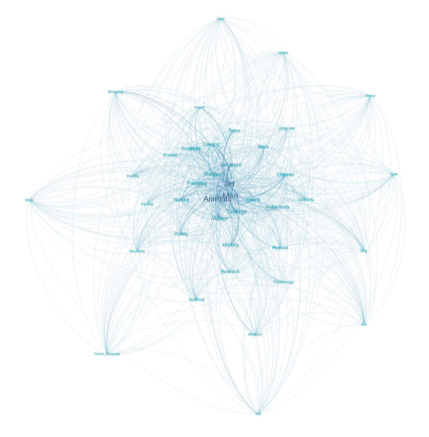
Network graph showing 40 most frequent keywords in a subset of 205 pages from the scrapbooks, represented as a bibliographic coupling network. Node label size represents degree, ie. frequency with which the keywords appear. Colour represents closeness centrality, ie. the darker a node's label is, the closer it is to all the other nodes in the network. The closer two nodes are, the more likely they are to appear on the same scrapbook pages. Constructed with Gephi. (click on image to enlarge)
Eye-Tracking Experiments
Akmal Putra and Bridget Moynihan conducted eye-tracking experiments in 2017. In part, these experiments considered how participants interacted with digital facsimile versions of 8 pages from the Morgan scrapbooks. The experiments also compared these facsimile results to eye-tracking results for our custom visualizations based on these same pages. The visualizations abstracted the scrapbook pages by focusing on the colour, size, and layout of their various visual and texual components, rather than on their faithful reproduction. Heat maps showing the aggregate results for some of these pages are shown below.
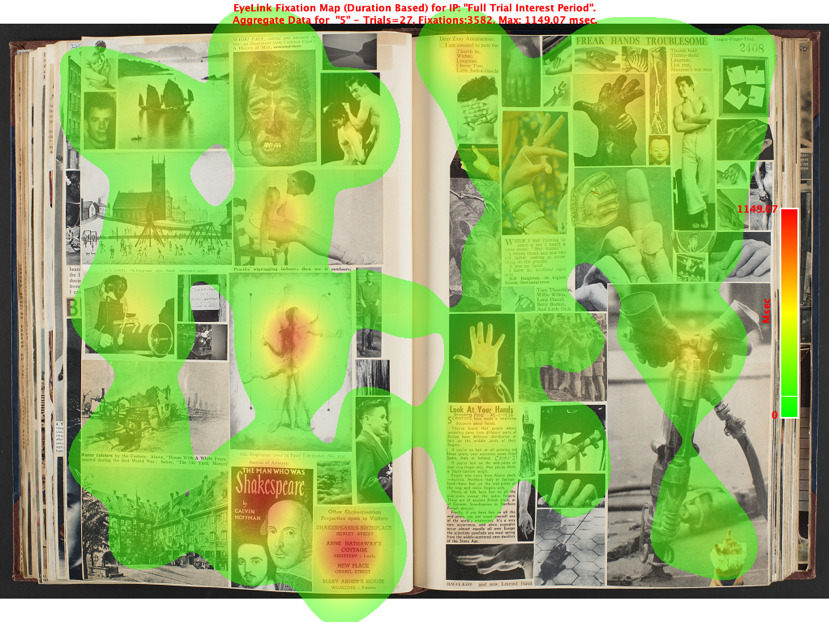
Scrapbook 12, facsimile, Pages 2407-2408 (click on image to enlarge)
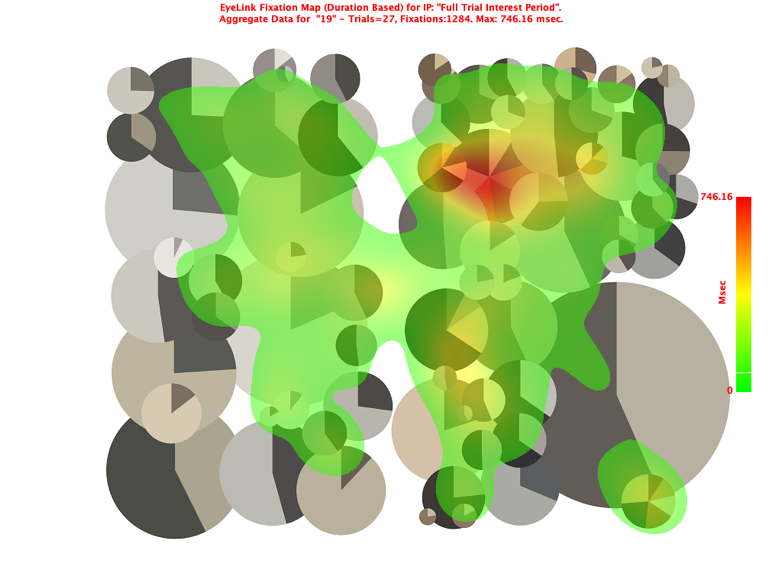
Scrapbook 12, visualization, Pages 2407-2408 (click on image to enlarge)
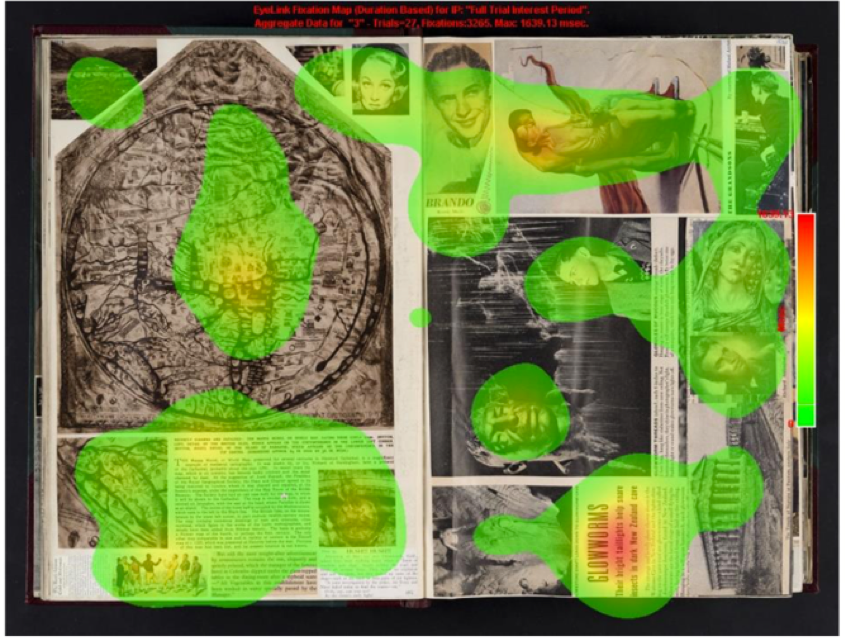
Scrapbook 9, facsimile, Pages 1519-1520 (click on image to enlarge)
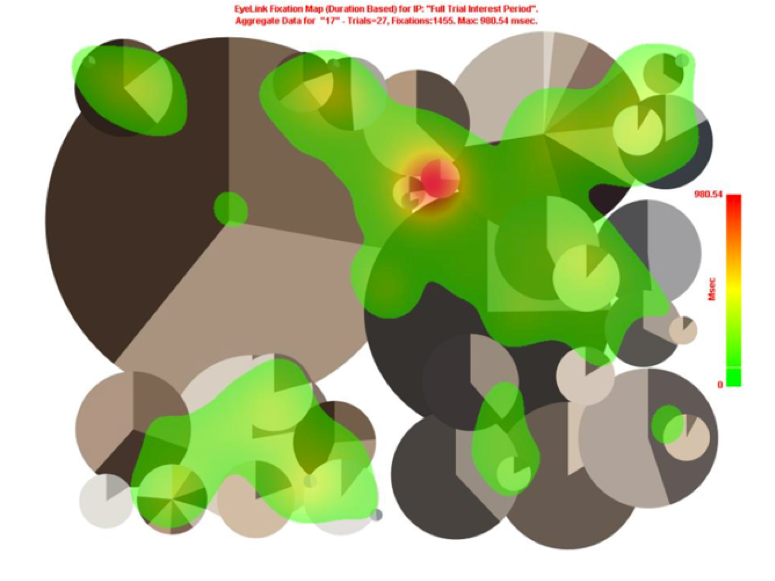
Scrapbook 9, visualization, Pages 1519-1520 (click on image to enlarge)
Aligning with existing eye-tracking findings, the results for the facsimile scrapbook pages show that faces and text drew the most attention from our participants, as indicated by the red hot spots on the heat maps shown above. The heat maps for the abstracted visualizations, however, which do not include images of faces or reproductions of text, show hotspots around many of the same general areas of the page as those shown for the facsimile pages. These recurring hotspots between the two types of page representations demonstate the more subtle influence of page layout in guiding the eye of the viewer, with more densely populated places attracting more attention, as shown in the heat maps above. That the viewing patterns between the two types of page representations still largely mirror each other indicates the combined impact of clipping density and arrangement on the gestalt and structure of the scrapbook pages, alongside visual cues like faces that attract attention.
It must also be noted that, in some cases, new hotspots emerged on the abstracted pages when compared with the heat maps for the facsimile images. These often occurred where brightly coloured clippings were represented, thus indicating the significant ability of colour to direct visual attention.
For a discussion of the full eye-tracking experiments and results, including a comparison of Morgan's scrapbook pages with his concrete poetry, see Moynihan's thesis, Chapter 3.
Eye-Tracking video showing participant scanning Scrapbook 9, Pages 1519-1520 (click on video to expand and control playback)
Research questions
-
What productive possibilities for reproducing and remediating cultural objects arise when we move beyond the notion of digitised facsimiles and instead focus on the specific affordances of digital media?
-
How can digital media and their associated methods of meaning-making be deployed in the service of representing the specificity of print-based ephemera? And how do users make sense of, and respond to, such digital remediations of cultural objects?
-
What interpretative possibilities are offered by algorithmic transformations of textual, semantic, visual and structural elements of cultural objects for which straightforward digitisation is not possible? And how might libraries and archives make use of these possibilities in the effort to preserve their collections, adhere to copyright regulations, and make their holdings as widely accessible as possible?